
Search Maryland Deed Records
Maryland deed records are public documents that show who owns real property across all 24 counties and Baltimore City. The state keeps these records through a joint system run by the Maryland Judiciary, elected Circuit Court Clerks, and the Maryland State Archives. You can search Maryland deed records for free online, visit a courthouse, or request copies by mail. This guide covers where to look, what you will find, and how to get copies of deed records in Maryland.
Maryland Deed Records at a Glance
MDLandRec.net: The Free Maryland Deed Records Database
The main place to search Maryland deed records online is MDLandRec.net, now hosted at landrec.msa.maryland.gov. This system is a joint project of the Maryland Judiciary, the 24 elected Circuit Court Clerks, and the Maryland State Archives. It gives free access to deed records from every county and Baltimore City. Some county deed books go back to the 1600s. You must create a free account with the Maryland State Archives to view records. Version 5.0.0 launched in November 2024 and added multi-factor authentication, so the system sends a security code to your email each time you sign in.
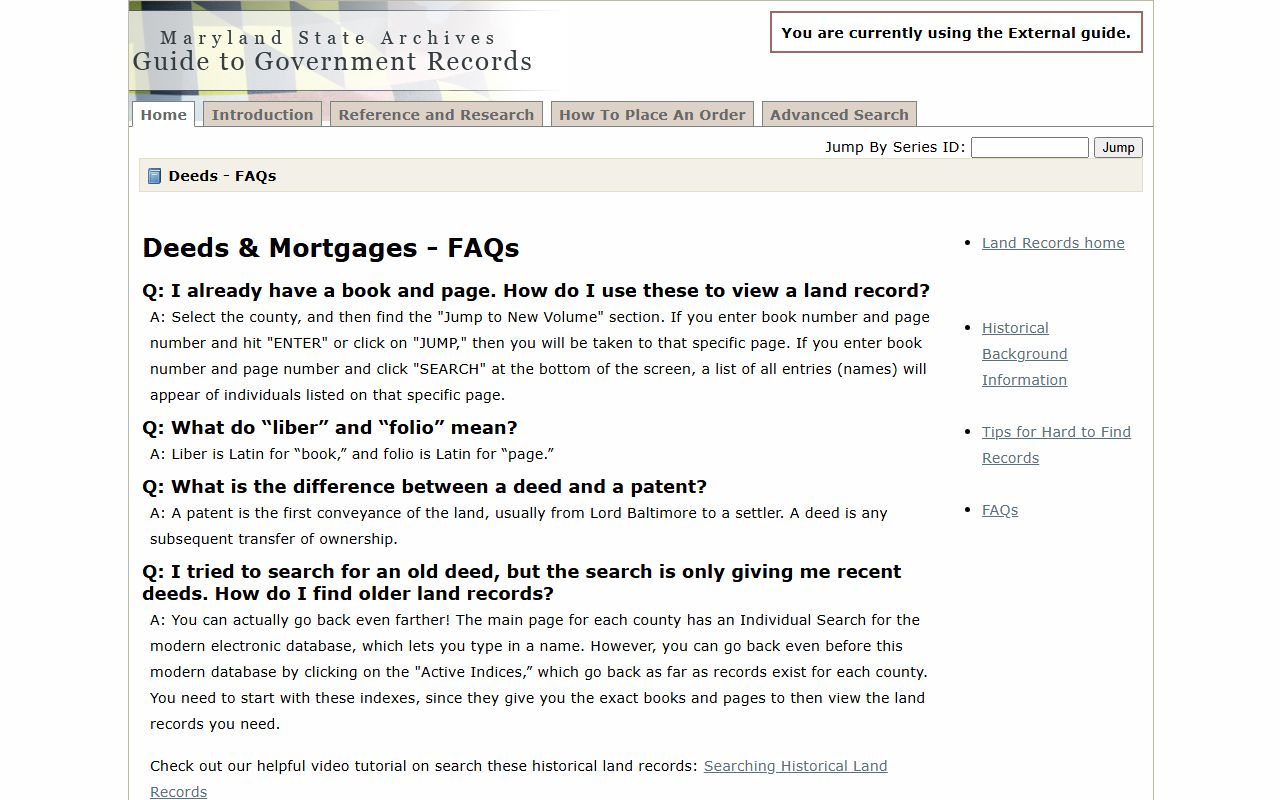
Once you are logged in, three search paths are available. The individual name search covers the modern electronic database, which typically starts from the 1950s to 1970s depending on the county. The Jump to New Volume tool lets you go straight to a document if you already have the liber and folio numbers. For older deed records, you browse the Historical Indices, which are scanned images of old index books organized by last name or business name. Historical Indices let you find the book and page, and then Jump to New Volume pulls up the actual deed document. This system can take you back to the earliest surviving records for some Maryland counties, including colonial land patents from Lord Baltimore himself.
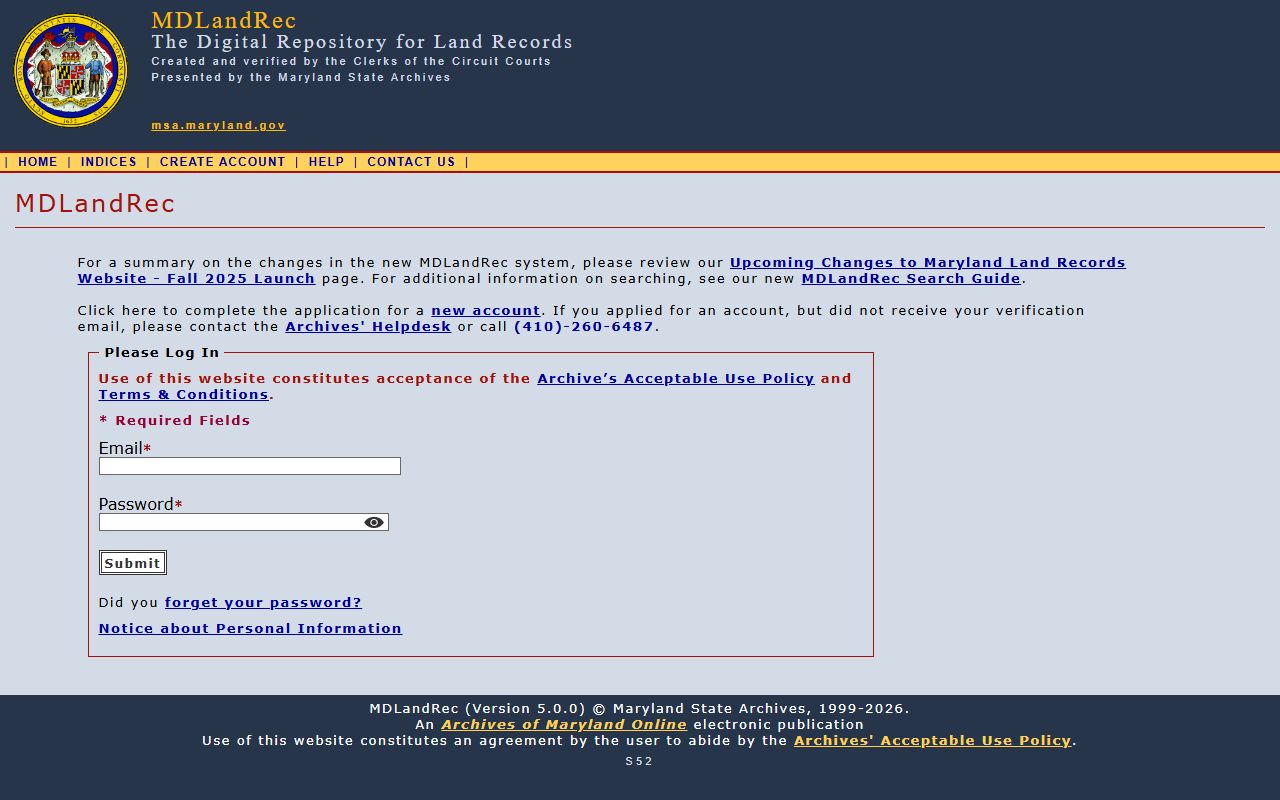
When searching by name, use modifiers like "Begins With," "Ends With," or "Contains" to catch partial matches. Each county's main page shows the date range covered by the name search tool. Records before that range require the Historical Indices first. The system stores deed books in Latin terminology: "liber" means book and "folio" means page. Every deed reference in Maryland uses this format.
Note: MDLandRec is free to use but requires a Maryland State Archives account. You can register at the same site. Account approval typically takes less than one business day.
Using SDAT to Find Maryland Deed Reference Numbers
The State Department of Assessments and Taxation maintains records on about 2 million property parcels in Maryland. Their Real Property Data Search at sdat.dat.maryland.gov is the best way to find a deed reference number before you go to MDLandRec. Search by street address, owner name, or property account number. The deed reference appears in the owner information section of the results. It shows the liber first, then a backslash, then the folio. Take those numbers to MDLandRec and use Jump to New Volume to pull up the deed directly. No account is needed for SDAT.
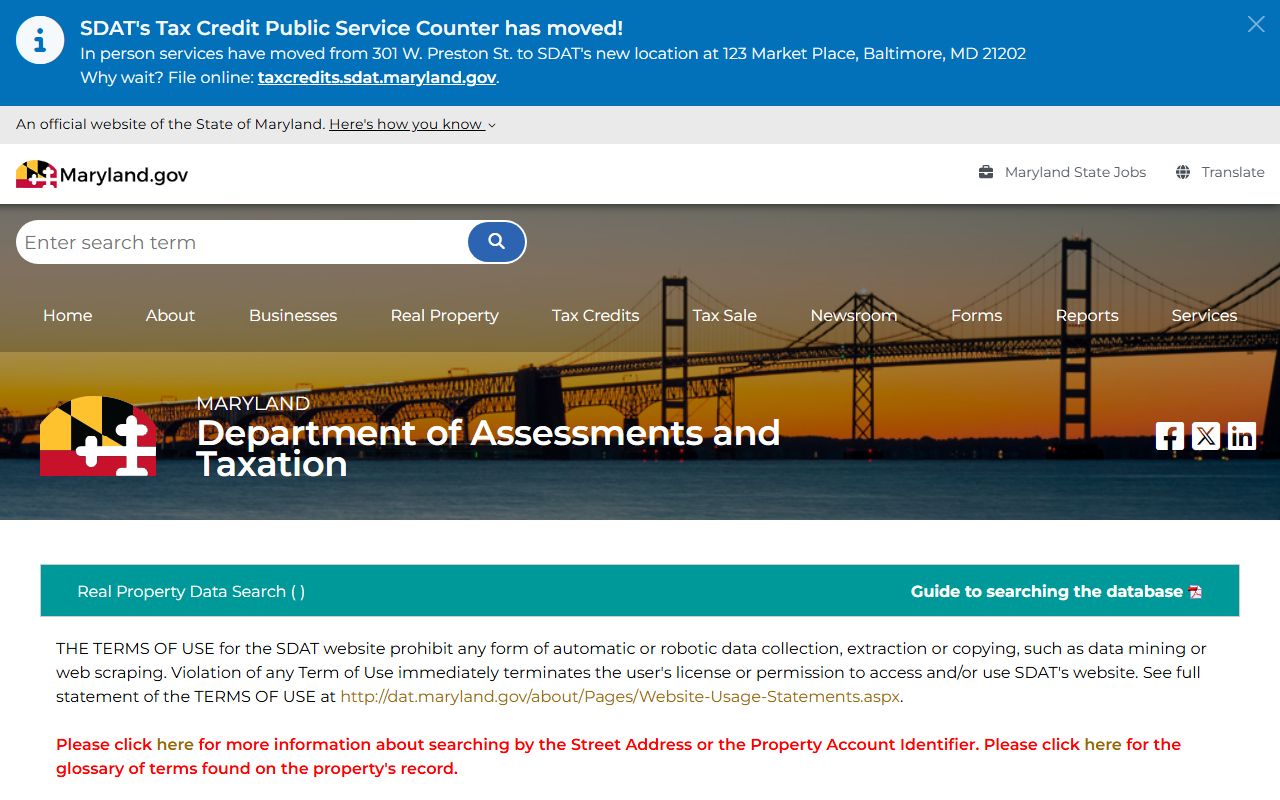
When you search SDAT by address, skip street directions like North or Southeast. Do not add suffixes like Avenue or Street. If the search fails, try leaving off the street number and search by name alone. Use an asterisk as a wildcard in the street name field if you are not sure of the exact spelling. Each county has a two-digit code in the SDAT system. Allegany County is 01, Baltimore City is 03, Baltimore County is 04, Frederick is 11, Montgomery is 16, and Prince George's County is 17.
SDAT also shows current ownership details, recent sales and transfer data, property assessments, tax maps, ground rent registration status, and property characteristics like year built and square footage. This makes it a useful first stop for any Maryland deed records search.
How to Search and Request Maryland Deed Records
Maryland deed records can be searched online, in person, or by mail. Online is fastest for most people. In-person visits work well when you need certified copies or want to look through old hardbound deed books. Mail requests take longer but work fine if you already have the liber and folio. All 24 circuit courts have public research rooms with computer terminals, self-service copying, and staff who can help you locate records.
A step-by-step chain of title search starts at SDAT. Enter the property address to get the deed reference number. Then open MDLandRec, select the county, and use Jump to New Volume with the liber and folio. The deed you find will include a phrase near the property description that starts with words like "Being the same lot..." followed by a reference to the prior deed. Enter that earlier reference into Jump to New Volume to find the previous deed. Repeat this process backward through time, deed by deed, and you can sometimes trace a property all the way to an original land patent. Under Real Property Article § 3-201, a deed's effective date is the date of delivery, and once recorded it binds all parties and serves as constructive notice to the public.
To request copies by mail, write to the Circuit Court Clerk in the county where the land is located. Include the liber and folio number, the total number of pages you need, and a check for $0.50 per page. Certified copies cost an extra $5.00 per document. Mail the check payable to Clerk of the Circuit Court. Most offices respond within one to two weeks.
Electronic recording, called e-recording, is now available in most Maryland counties through Simplifile. Title companies and attorneys use e-recording to submit deed packages without a trip to the courthouse. Original deeds are mailed back to the owner four to six weeks after recording at no charge. If you receive a bill asking you to pay for a copy of your newly recorded deed, that is a known scam and should be ignored.
Types of Maryland Deed Records and What They Contain
A Maryland deed is a legal document that transfers ownership of real property from one party to another. Warranty deeds are most common for property sales. The seller guarantees clear title and promises to defend the buyer if anyone later claims an interest. Quitclaim deeds transfer only whatever interest the seller has, with no guarantees. You will also see deed of trust documents, which secure a mortgage loan against the property. Under Real Property Article § 3-101, instruments transferring real property must be recorded in the county where the land is located. If a parcel spans two counties, recording in both counties is required.
The land records system also holds mortgages, releases of liens, assignments, leases, ground leases, easements, and other instruments affecting property. Each document gets its own liber and folio when recorded. Under Real Property Article § 3-102, additional instruments that may be recorded include contracts for the grant of property, subordination agreements, boundary survey plats, assumption agreements, and ground rent redemption certificates. Recording any of these creates constructive notice from the date of recording.
A typical Maryland deed lists the grantor's name, the grantee's name, the consideration paid, a legal property description, and a reference to the prior deed. Legal descriptions use metes and bounds, lot and block numbers from a recorded plat, or both. Every deed also carries the date acknowledged before a notary and the date recorded at the courthouse. Under Real Property Article § 3-104, documents must have a three-inch top margin on the first page, one-inch side margins throughout, and names printed above or below each signature. Documents that do not meet these requirements face triple recording fees as a penalty.
Recording Fees and Taxes for Maryland Deed Records
Recording a deed in Maryland costs more than just the base fee. The standard recording fee for most instruments nine pages or fewer is $20.00. Releases of liens that are nine pages or fewer cost $10.00. Documents running ten pages or more cost $75.00. On top of that, a $40.00 surcharge applies to almost every recordable instrument recorded among land records in Maryland. The surcharge was extended through Chapter 538 of the 2020 Maryland General Assembly session.
Two taxes apply to most deed transfers in Maryland. The state recordation tax rate is set by each jurisdiction and typically falls between $2.50 and $7.00 per $500 of consideration, rounded up to the nearest $500. Howard County is at the low end at $2.50 per $500. Frederick County is at the high end at $7.00 per $500. Under Tax-Property Article § 12-105, the tax is computed based on the consideration paid or the debt secured, rounded up. The state transfer tax is 0.5% of the sale price for most buyers. First-time Maryland homebuyers pay only 0.25%, and the seller must cover that reduced rate under the statute.
Under Tax-Property Article § 12-108, many transfers are exempt from the recordation tax. Exempt transfers include those between spouses or domestic partners, between parents and children or stepchildren, between siblings, from estates to heirs, and transfers to or from government entities. Many counties also collect their own transfer tax. Baltimore City charges 1.5%, or 2.1% if the transaction exceeds $1 million and also carries a yield tax. Howard County charges 1.25% and Harford County charges 1.0%. Some counties like Carroll County have no county transfer tax at all. Always check the specific county before closing.
Note: Copy fees are $0.50 per page at most Maryland courts. Certified copies cost an extra $5.00 per document, and exemplified copies with triple seals cost $10.00.
Maryland Ground Rents: A Unique Property System
Maryland has a ground rent system that makes its deed records different from nearly every other state. In a ground rent arrangement, the homeowner owns the building but leases the land itself under a long-term ground lease, typically 99 years and renewable forever. Ground rents are most common in Baltimore City, where they date back to colonial times, but they exist in other parts of Maryland too. When you search deed records for a Baltimore property, you may find a ground lease recorded alongside or instead of a standard deed. The land and the building can transfer separately in these cases.
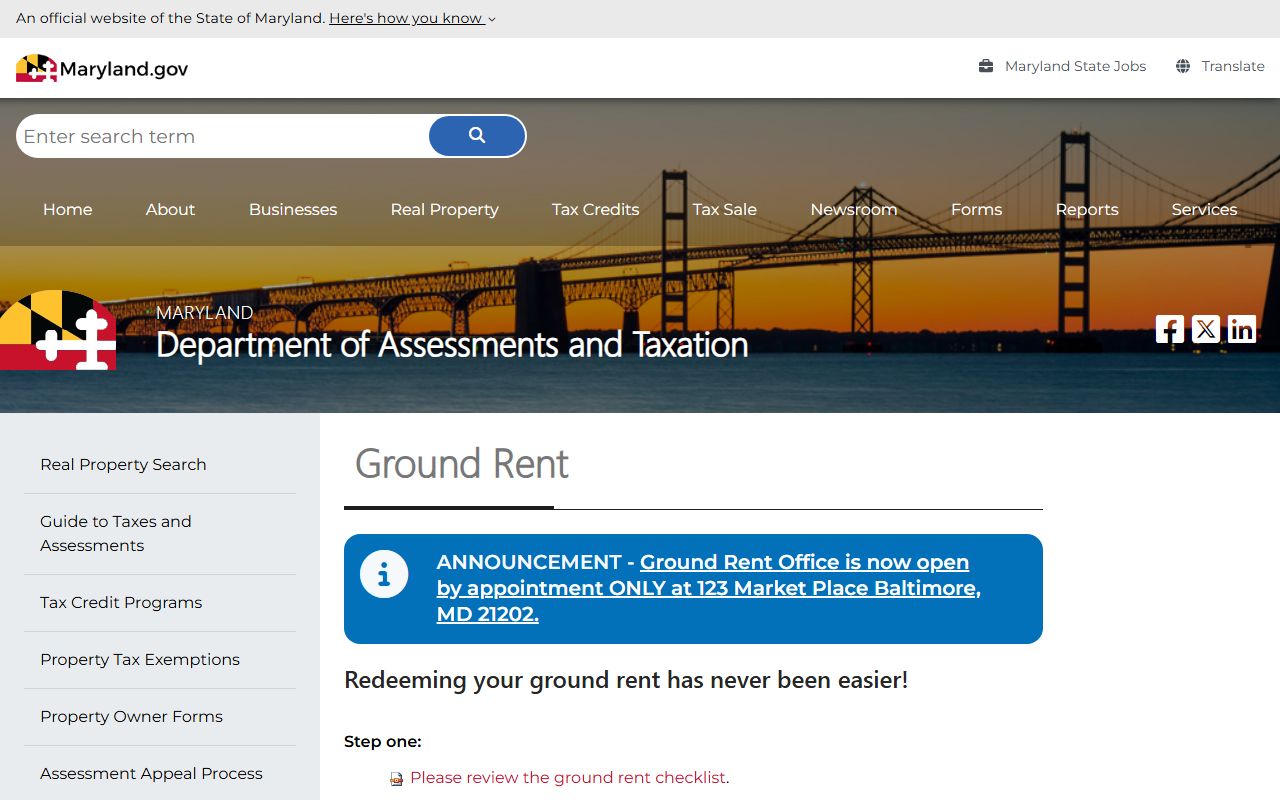
Ground rents created after April 8, 1884 can be redeemed, meaning the homeowner pays a set amount to take full ownership of the land. As of April 1, 2023, all previously irredeemable ground rents became redeemable under Maryland law. SDAT maintains a public registry of ground rents at dat.maryland.gov. Ground rents that were not registered with SDAT after 2007 cannot be legally collected. Financial assistance for income-eligible homeowners seeking to redeem ground rents is available through the Maryland Department of Housing and Community Development. A 2008 law under Tax-Property Article § 12-117 also prevents tax avoidance by taxing transfers of controlling interests of more than 80% in real property entities.
Finding Liens, Judgments, and Related Maryland Records
Not all liens show up in the land records. Judgment liens from court cases and foreclosure cases are held by the Civil Clerk at the Circuit Court, separate from the Land Records Department. To find those, use the Maryland Judiciary Case Search at casesearch.courts.state.md.us. As of December 7, 2021, the system defaults to exact name searches. To do a partial name search, enter at least the first character of the last name followed by a percent sign as a wildcard.
Property tax liens do not appear in land records either. Contact the county finance or treasury office for those. Mechanic's liens may be filed at Land Records or held at the municipal level, depending on the county. A complete title search requires checking all three sources: Land Records through MDLandRec, court judgments through Case Search, and unpaid tax or utility liens at the county finance office. Most buyers hire a title company or attorney to run this search before closing on a property in Maryland.
The Maryland State Archives Help Desk at 410-260-6487 or msa.helpdesk@maryland.gov can assist with older deed searches and questions about historical records. The Archives office is at 350 Rowe Blvd., Annapolis, MD 21401.
Subdivision Plats and Survey Maps in Maryland
Plat maps are kept separately from deed books in Maryland. The Plats.net system, now at plats.msa.maryland.gov, preserves and gives access to all land survey, subdivision, and condominium plats filed with the Maryland Land Office and Circuit Courts. Log in with the public username "plato" and password "plato#". Plats show lot lines and subdivision layouts rather than exact house placement. They are most useful when a deed description references a specific lot on a recorded plat, and you need to view that plat to understand the property boundaries.
The Maryland State Archives holds colonial land records that go back to the 1600s. These include original land patents, bills of sale, manumissions, and certificates of freedom from the pre-Emancipation era, all accessible through the MDLandRec Historical Indices. For Baltimore City specifically, block books from 1851 to 1953 let you research properties by address rather than owner name, which is useful for old city properties where ownership changed frequently. The guide at guide.msa.maryland.gov answers common questions about deed terminology, search tips, and how to trace a chain of title using the Archives collections.
Browse Maryland Deed Records by County
Each of Maryland's 24 jurisdictions has its own Circuit Court Land Records office. Pick a county below to find local contact details, office hours, and resources for deed records in that area.
Deed Records in Major Maryland Cities
Property owners in Maryland's largest communities file deed records at the county Circuit Court that serves their area. Pick a city below to find specific resources and search guidance for deed records near you.